

Safety Label Guidance and Solutions With Brother
Safety label standards play a vital role in keeping workplaces safe, compliant and easy to navigate. This article explores what safety warning labels are, why they matter, and how they’re used across UK industries.
You’ll also find practical guidance on how to safety label effectively, along with an overview of Brother’s integrated safety labelling solutions.
What Are Safety Labels?
Safety labels are identifiers that communicate important information to users and operators of equipment or products. These include chemical, electrical and fire safety labels that highlight potential hazards and provide instructions for safe use.
These labels highlight potential hazards, offer instructions for safe use, and often include symbols or pictograms for quick comprehension. By providing clear guidance, each safety label plays an essential role in safeguarding individuals across various settings.
Why Are Safety Labels Important?
Safety labels do one job brilliantly: they stop accidents before they happen. When hazards are clearly marked, people make safer decisions — and the ripple effect across a workplace is huge.
Did you know that HSE data shows 680,000 UK workers were injured in 2024/25, with slips and trips the biggest cause?
Effective safety labelling reduces risks, including injuries, equipment misuse and compliance breaches.
The impact of utilising safety labels:
-
Fewer injuries = lower absence and compensation costs.
-
Stronger compliance = fewer fines and smoother audits.
-
Clearer workflows = less confusion and faster training.
-
Less downtime = higher productivity.
When safety labels do their job, everyone benefits—safer teams, smoother workflows, and a workplace that avoids problems before they begin.
What Are the 4 Categories of Safety Signs and Their Meanings?
Safety signs are divided into four categories, each serving a distinct purpose to ensure safety and awareness of potential dangers.
The categories include:
-
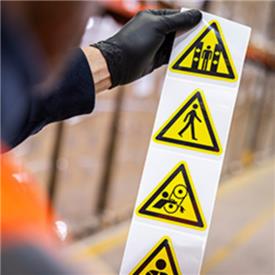
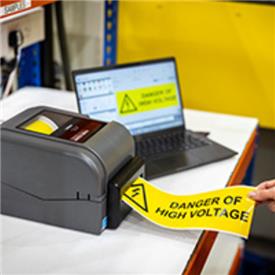
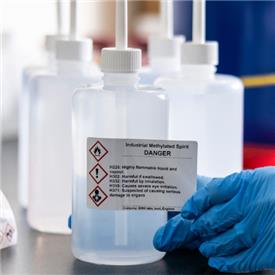
Warning safety signs — highlighting potential hazards in the nearby area. Warning signs are typically yellow and black with a triangle shape. For example, labels for hazardous materials on chemical storage barrels or electrical warning labels for high-voltage areas.
-
Prohibition safety signs — indicating that a specific action is not allowed, usually due to an increased risk of danger. Prohibition labels are displayed as a red circle outline with a diagonal line across the prohibited activity icon. For example, fire safety signs that prevent smoking in an area with highly flammable materials.
-
Mandatory safety signs — instructing which actions need to be taken for health and safety requirements. They appear as blue circles with a white icon or sometimes an exclamation mark. For example, a ‘wash your hands’ sign within a food-prep area.
-
Emergency safety signs — providing guidance for emergency situations. They are generally a green square or rectangle with white icons or text. For example, an ‘emergency exit’ sign above a doorway.
These standardised signs directly influence how we organise warning labels across UK organisations.
Developing Safety Label Trends
The UK’s safety landscape is shifting, and these trends will shape how businesses approach labelling over the coming years.
GB CLP Divergence
Following Brexit, Great Britain now manages its own CLP (Classification, Labelling and Packaging) regulations, separate from the EU framework. Recent analysis from Knoell (2026) shows that around 11% of chemical classifications already differ between GB and the EU. For organisations operating across UK–EU supply chains, this can potentially create inconsistency with warning symbol labels. Flexible, on-demand custom safety label printing can help to keep pace with evolving regulatory compliance.
Sustainability and Wastage
As circular supply chain models gain momentum, organisations are increasingly focused on cutting unnecessary waste (Institute of Sustainability Studies, 2024). One practical area of improvement is reducing reliance on bulk pre-printed warning labels, which often lead to excess stock and avoidable waste. On-demand labelling supports both sustainability goals and operational efficiency.
How to Safely Label
A strong safety labelling workflow follows three principles:
-
Identify hazards clearly
-
Communicate risks consistently
-
Use durable, compliant materials
This ensures every label is readable, reliable and fit for the environment it’s placed in.
Tips For Effective Safety Labelling
Your labelling processes are dependent on your workflows, but we’ve included a few pointers to get you started.
-
Start with a hazard audit — walk the site and identify where labels are missing, damaged or unclear.
-
Standardise your templates — use consistent colours, icons and wording across all sites. See the safety signs section above for more information around prohibition, mandatory and warning label standards.
-
Choose the right material — harsh environments need chemical-resistant, UV-resistant or abrasion-resistant media.
-
Keep labels up to date — review them during maintenance cycles or when processes change.
-
Print on demand — avoid waste and keep labels current.
UK Health and Safety Labelling Regulations
Safety labels and signs must align with UK-specific requirements, which may include:
-
GB CLP for chemical classification and pictograms.
-
GHS alignment for hazard statements and precautionary wording.
-
ISO/BS standards for colour coding, signage and symbol consistency.
-
HSE guidance on hazard communication and safety in the workplace.
These frameworks ensure health, safety and warning labels communicate risks clearly and legally.
Designing and Printing Safety Labels
Designing effective safety labels means combining clarity, compliance and durability:
-
Use high-contrast layouts for visibility.
-
Include pictograms for universal understanding
-
Add QR codes for digital instructions or safety data sheet access
-
Select durable media suited to chemicals, heat, cold or abrasion
To make this process easier, many organisations choose on-demand printers that deliver compliant labels without the waste of pre-printed stock. Brother’s safety labelling solutions include durable media, design software and printers. Keep reading to find out how they give organisations flexibility and reliability with their health, safety and warning labels.
Brother Safety Label Solutions
Brother’s safety label range is built for organisations that want compliance and control in a continuously evolving landscape. From complete print bundles to media and software, each component is engineered to work together.
Benefits At A Glance
-
Simplified compliance.
-
Reduced waste from pre-printed stock.
-
Complete solutions with printer bundles.
-
Lower long-term costs.
-
Durable supplies.
Brother's solutions make safety labelling simple by combining hardware, software and materials into a seamless workflow.
Safety Label Printer Bundles
Brother has your safety labelling workflows covered with three options to choose from:
-
Complete package – ideal for standard safety labelling, this bundle includes a TD-4420TN thermal label printer, PACU003 cutter and SafetyLabelPro software.
-
Higher res bundle – for higher detail requirements, this package upgrades the previous option with a TD-4520TN 300 dpi printer.
-
Printer-only option – for expanding existing setups, this bundle provides a TD-4420TN print and cutter for operations that already have compatible label design software.
Each bundle includes the core elements to start printing labels on-demand.
SafetyLabelPro Software and Label Media
SafetyLabelPro works with Brother’s TD4 printers, giving teams access to thousands of compliant templates across safety categories.
Its guided design process walks users through each step — from choosing the label type to selecting layouts. It even automatically recommends the right materials for the job. Every template can be adapted to site-specific requirements, with no ongoing licence fees and minimal IT involvement needed.
Businesses can select from a wide range of vinyl labels and ribbons to match their operational requirements.
If you’re interested in learning more, contact ERS to arrange a SafetyLabel Pro trial.
Applications include:
-
CLP/GHS chemical labels, including hazard warning labels
-
Pipe marking labels
-
Prohibition signs, warning labels and LOTO tags
-
Specialist vinyl labels
-
Rack and asset labels
-
Inspection labels
Designed for durability, these labels resist UV, chemicals, abrasion and temperature variations, supporting performance for up to eight years in demanding environments.
Discover Brother's range of essential safety labels below.
Resin Colour RibbonsContinuous Vinyl Rolls
Die-Cut Thermal Transfer Label RollsShelving Rack Thermal Transfer Rolls
Brother's safety label sample pack is available on request and includes examples of safety labels and signs.
Why Choose Brother’s Safety Labelling Solutions?
Brother offers a safety labelling system built to give organisations complete confidence and control. Their hardware, software and materials are integrated by design, working seamlessly together to deliver consistent results across every label. European-manufactured supplies are engineered for durability, built to withstand chemicals, abrasion and demanding industrial conditions.
Brother also provides ongoing support across printers, software and media, helping organisations maintain safe, compliant and efficient labelling processes long-term.
In addition to the solutions above, you can also explore the P-Touch range for healthcare, facilities management and electrical labels. The TJ series is another great option for harsher, more industrial operations which need higher volumes of hazard warning signs and labels.
Get Started With Your Safety Labelling
Safety label workflows are one of the simplest and most effective ways to strengthen workplace safety, reduce accidents and support compliance.
Brother’s integrated hardware, software, and durable media give teams the tools to stay in control with their health and safety workflows. Create safer environments, smoother operations, and a future-ready approach to hazard communication.
Get in touch with ERS, your local Brother expert, or explore Brother solutions to learn more.